The story so far

A thousand years on the river.

Wapping is one of London's oldest riverside parishes — a place where every wall and water-stair carries a story.

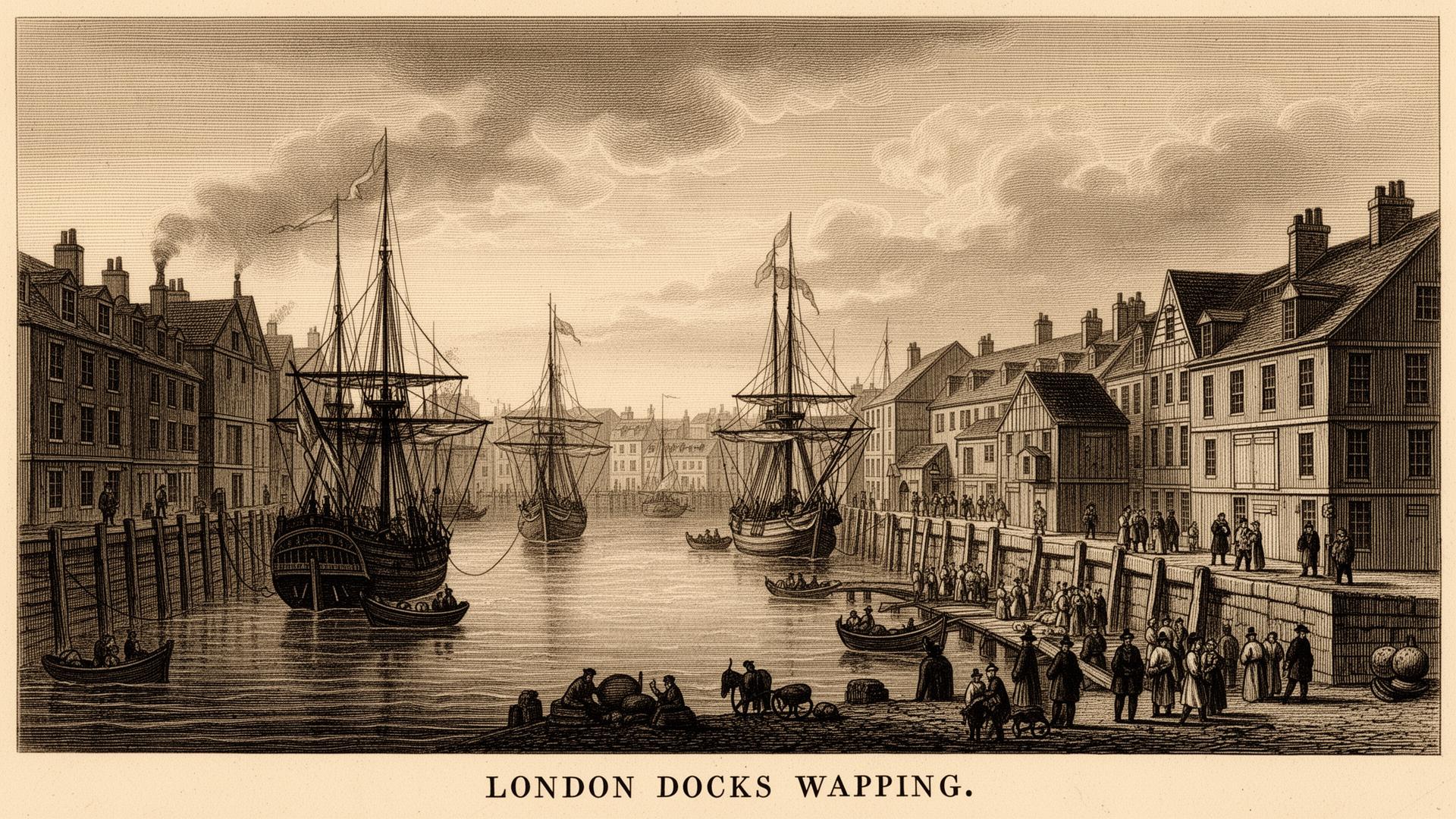
London Docks at Wapping, 19th-century engraving

c. 900 – 1100

01

Wæppa's people

The name 'Wapping' is older than London's stone walls. It is thought to derive from Wæppa, a Saxon chieftain whose followers — the Wæppingas — settled this low-lying strip of marsh between the Tower and the Lea. For two centuries it was little more than reed-beds, eel traps and a few thatched huts on raised ground above the tide.

1100s – 1500s

02

A marsh on the river

Wapping began as a tiny medieval hamlet on a strip of reclaimed marshland east of the Tower. Fishermen and watermen settled along the foreshore, drawing a livelihood from the tide. The first sea wall was raised by Cornelius Vanderdelft in the sixteenth century — the line of it still shapes the streets today. Wapping High Street, running atop that wall, is one of the oldest continuously inhabited streets in east London.

1500s – 1700s

03

Execution Dock

Engraving of Captain William Kidd hanging in chains at Tilbury Point after his execution at Wapping in 1701
Public domain, via Wikimedia Commons

By Tudor times Wapping had become the home of London's seafaring trades — and of the Admiralty's grim justice. Pirates, mutineers and smugglers were hanged at Execution Dock at the river's edge, their bodies left until three tides had washed over them. Captain Kidd met his end here in 1701; his corpse was tarred and gibbeted at Tilbury Point as a warning to seafarers entering the Thames.

1660 – 1750

04

Pepys, plague and shipwrights

Portrait of Samuel Pepys, diarist and Secretary to the Admiralty
Royal Museums Greenwich, public domain

Samuel Pepys, Secretary to the Admiralty, walked Wapping's lanes on naval business and recorded its rough character in his diary. The parish escaped the Great Fire of 1666 — the wind blew the flames the other way — but plague had thinned its alleys the year before. Shipwrights, ropemakers, biscuit-bakers and chandlers crowded the High Street, supplying the men-of-war fitting out at Deptford and Woolwich.

1750 – 1800

05

The river police

By the late eighteenth century the Pool of London was the busiest anchorage on earth, and pilfering from moored ships was costing merchants a fortune. In 1798 the magistrate Patrick Colquhoun and the Scottish seaman John Harriott founded the Marine Police Force at 259 Wapping High Street — the first organised police force in the world, three decades before Peel's Metropolitan Police. The headquarters of the Marine Policing Unit still stands on the same spot today.

1805

06

The London Docks

Elevated 19th-century view of the new London Docks at Wapping
Public domain, via Wikimedia Commons

The opening of the London Docks in 1805 transformed the parish. Designed by Daniel Asher Alexander and built behind massive brick perimeter walls to deter the river thieves, vast walled basins were carved into the marsh; warehouses rose five storeys above the water, fragrant with tobacco, sugar, brandy, ivory and wool. The Tobacco Dock vaults — still standing — could hold 24,000 hogsheads. Wapping became, for a century, the busiest port on earth.

1843

07

Brunel's tunnel

Mid-19th-century engraving of pedestrians inside Brunel's Thames Tunnel between Wapping and Rotherhithe
Public domain, via Wikimedia Commons

After eighteen years of flooding, deaths and bankruptcy, Marc Isambard Brunel's Thames Tunnel between Wapping and Rotherhithe opened in March 1843 — the first tunnel ever driven beneath a navigable river. It was hailed as the eighth wonder of the world; on its first day fifty thousand people paid a penny to walk through. The tunnel still carries Overground trains today, and Brunel's original Engine House survives as a museum on the Rotherhithe side.

1889

08

The Great Dock Strike

In August 1889 the dockers of Wapping and the surrounding wharves walked out, demanding the 'dockers' tanner' — sixpence an hour. Led by Ben Tillett, John Burns and Tom Mann, the strike held for five weeks and won. It is remembered as the founding moment of modern British trade unionism, and Wapping's casual labourers — who had been hired by the half-day at the dock gates — were among its hardest fighters.

1911

09

The Siege of Sidney Street

Though the siege itself took place a mile north in Stepney, its prelude played out in Wapping: a gang of Latvian anarchists fled through the parish after the Houndsditch murders of December 1910, hiding in the warren of dock-side lodgings before being cornered. Home Secretary Winston Churchill came to watch the final assault — one of the strangest cameos in the area's strange history.

1936

10

The Battle of Cable Street

The Cable Street Mural on St George's Town Hall, commemorating the 1936 Battle of Cable Street
Geograph / Wikimedia Commons, CC BY-SA

On 4 October 1936, Oswald Mosley's British Union of Fascists attempted to march through the East End. Wapping dockers, Jewish tailors from Whitechapel, Irish labourers and Bengali seamen joined a crowd of three hundred thousand to block them at Cable Street, just north of the parish boundary. The barricades held; the march was abandoned. The mural on St George's Town Hall commemorates a day that drew its strength from Wapping's wharves as much as from anywhere.

1940 – 1945

11

The Blitz

St Paul's Cathedral standing amid smoke and fire during the Blitz, 29 December 1940
Herbert Mason / Daily Mail, public domain via Wikimedia Commons

Wapping's wharves and warehouses made it a primary target. On 7 September 1940, the first night of the Blitz, the docks were set alight — the fires visible across England. Whole streets were lost: of the parish's pre-war housing stock, more than a third was destroyed or made uninhabitable. The community held on, sheltering in the Wapping Tunnel and the deep cellars of the Tobacco Dock vaults.

1969

12

The docks close

Containerisation moved trade downriver to Tilbury, and on 25 November 1969 the last commercial vessel left the London Docks. Within a year the basins were drained or filled in. Twelve thousand jobs vanished from the parish. For two decades Wapping stood half-empty, its warehouses boarded up, its population falling from over thirty thousand at its Victorian peak to barely four thousand by 1981.

1986

13

The Wapping dispute

On the night of 24 January 1986, Rupert Murdoch's News International moved its four national newspapers — The Times, The Sunday Times, The Sun and the News of the World — overnight from Fleet Street to a new fortified printing plant in Wapping. Six thousand print workers lost their jobs. The picket line outside 'Fortress Wapping' lasted thirteen months and ended in defeat for the unions. The dispute broke the power of the print chapels and remade the British newspaper industry.

1981 – 2000

14

Regeneration

The London Docklands Development Corporation, established in 1981, oversaw the transformation of the empty wharves. Warehouses became apartments, Tobacco Dock a venue, St Katharine's a marina. New residents — first journalists, then bankers, then artists and families — moved into converted lofts behind the high dock walls. By 2000, Wapping's population had recovered to fifteen thousand.

2010 – today

15

A village remembered

Today Wapping is a quiet, layered village — its history visible in every brick. The Overground (using Brunel's tunnel) reconnected it to the city in 2010. The riverside path, once private dockland, is now a continuous public walk from the Tower to Limehouse. The pubs that survived the docks — the Prospect of Whitby, the Town of Ramsgate, the Captain Kidd — pour the same beer to descendants of dockers and to the new arrivals alike. The river runs through it all.

At Wapping the Thames is not a view. It is a memory that never stopped flowing.